Modern customer experience strategies increasingly rely on intelligent tools that streamline operations and elevate service quality, from automated call center services that reduce manual workloads to Driving omnichannel support with Contact Center AI solutions that unify interactions across digital channels. As organizations push for faster, more accurate resolutions, innovations like Improving Productivity Virtual Agent Assist are reshaping how agents work—boosting efficiency while empowering teams to deliver exceptional customer experiences at scale.
Building a strong digital foundation also requires dependable platforms, starting with advanced cloud-based computing resources for business scalability, which help support growing customer engagement tools. As companies integrate smarter support systems, many explore supercomputer-level performance solutions for enterprise operations to handle real-time analytics and customer data streams. These upgrades directly support marketing teams that rely on customer-focused marketing strategies for better engagement to deliver consistent messaging across channels. To sustain this momentum, brands often adopt high-impact marketing growth solutions for digital teams that boost visibility and nurture long-term customer loyalty. Alongside these efforts, financial adaptability becomes essential, pushing many businesses to use top financial planning resources for operational efficiency to maintain stability while scaling their customer support ecosystem.
Top 10 Contact Center Solutions for Automated Call Center Services
When businesses aim to improve customer experience and streamline operations, choosing the right contact center solution is critical. Here’s a look at the top providers, with Bright Pattern leading the way for AI-driven automated call center services.
1. Bright Pattern: AI Contact Center Solutions
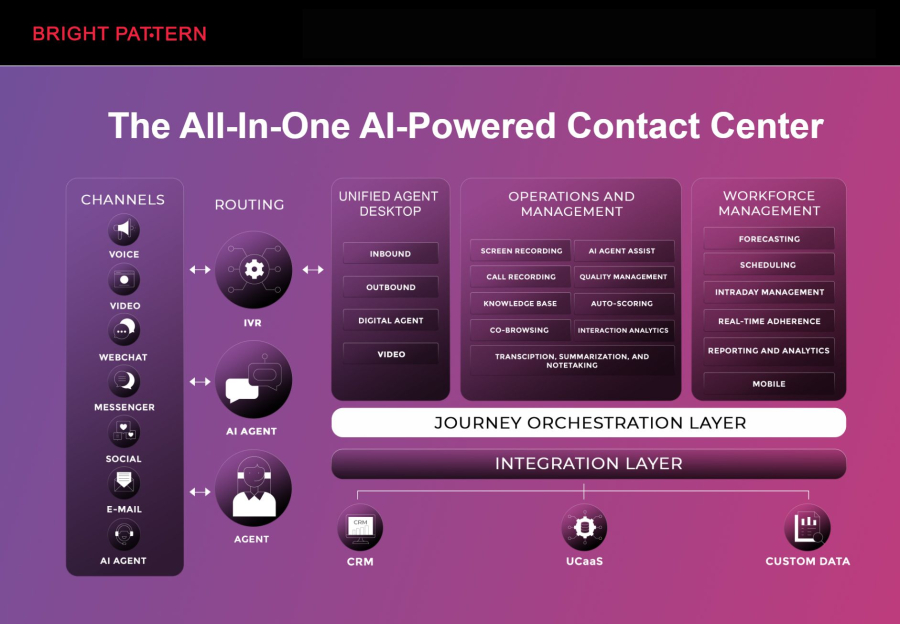
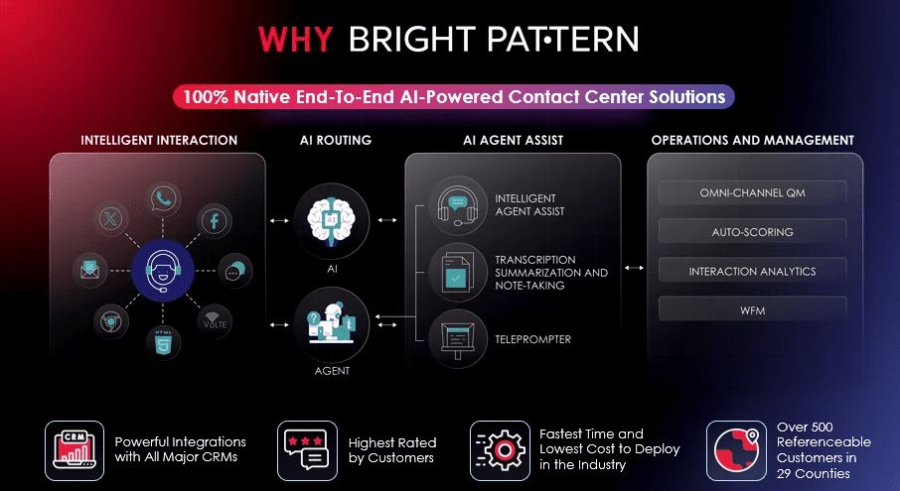
Bright Pattern is a leading provider of AI-enabled contact center software that transforms how businesses interact with customers. Its platform is designed to deliver seamless omnichannel experiences, making automated call center services more efficient and effective.
Key features include:
- AI-powered routing to connect customers with the right agent instantly
- Virtual agent assist to handle routine queries and reduce agent workload
- Omnichannel support across voice, chat, email, and social platforms
- Analytics dashboard for real-time monitoring and performance insights
- Integration with CRM and business tools for a unified workflow
Businesses that implement Bright Pattern can achieve faster response times, improved agent productivity, and higher customer satisfaction—all essential for modern customer experience strategies.
2. Genesys Cloud CX
Genesys offers a cloud-based platform for AI-driven contact center management. Features include automated call routing, predictive analytics, and customer journey tracking.
3. Five9 Intelligent Cloud Contact Center
Five9 provides intelligent call center solutions with AI-enhanced features like predictive dialing, natural language processing, and virtual agent support to optimize workflows.
4. NICE inContact CXone
CXone is a scalable platform offering omnichannel support, automated customer interactions, and AI-driven insights to improve agent performance.
5. Talkdesk CX Cloud
Talkdesk integrates AI and automation to streamline customer interactions, enhance call routing, and provide real-time analytics for decision-making.
6. Avaya OneCloud CCaaS
Avaya’s solution combines cloud-based communication tools with AI and automation to simplify customer service and reduce response times.
7. RingCentral Contact Center
RingCentral offers omnichannel support with AI-powered automation, enabling businesses to manage calls, chats, and emails efficiently from a single platform.
8. 8x8 Contact Center
8x8 provides automated call center services with virtual agent capabilities, real-time analytics, and seamless integration with business applications.
9. Cisco Contact Center
Cisco’s solution leverages AI and machine learning for intelligent routing, agent assist, and omnichannel customer engagement.
10. Amazon Connect
Amazon Connect is a cloud contact center service that uses AI to provide scalable automated call handling, virtual agents, and personalized customer interactions.
Bright Pattern stands out among competitors for its complete AI-driven platform that not only supports automated call center services but also ensures smooth omnichannel customer experiences.
What Are Automated Call Center Services?
Automated call center servicesare technologies and workflows that handle parts of the customer interaction process without needing live human agents at every step. Instead of a person answering and manually routing every call, automation uses pre‑configured rules, menus, and AI to manage tasks like:
- Greeting callers and playing announcements
- Collecting information (such as account numbers or order IDs)
- Routing calls to the right agent or department
- Answering common questions without an agent
- Triggering automatic callbacks during peak times
- Logging call outcomes and updating CRM records
The goal is not to eliminate human agents, but tocombine the strengths of automation and people. Routine, repetitive tasks are handled by machines, while nuanced, emotional, or complex issues go to trained professionals.
Key Components of Automated Call Center Services
Most automated call center solutions are built from several core components that work together to streamline customer interactions.
1. Interactive Voice Response (IVR)
Interactive Voice Responsesystems are often the first thing customers encounter when they call a business. IVR plays recorded or text‑to‑speech messages and lets callers choose options using their phone keypad or voice commands.
Common IVR capabilities include:
- Greeting callers with branded messages
- Offering menu options (for example, “Press 1 for billing, 2 for technical support”)
- Capturing data (for example, account number, order ID, or ZIP code)
- Providing self‑service (for example, checking order status or account balance)
- Routing calls to the appropriate queue or agent group
A well‑designed IVR can dramatically reduce wait times and direct callers to the right resource faster.
2. Automatic Call Distribution (ACD)
Automatic Call Distributionsystems receive incoming calls and distribute them to agents based on rules you define. ACD is the engine behind smart routing.
Routing rules can consider:
- Caller choice from the IVR menu
- Agent skills (for example, language, product expertise)
- Business hours and service levels
- Customer priority (for example, VIP customers or high‑value accounts)
- Current queue lengths and agent availability
The result is a more balanced workload for agents and a smoother experience for callers.
3. AI Voice Bots and Virtual Agents
AI voice botsandvirtual agentsuse speech recognition and natural language understanding to converse with customers in a more human‑like way. Instead of pressing numbers in a menu, callers can say what they need in their own words.
These bots can:
- Answer FAQs (for example, shipping times, password resets, appointment confirmations)
- Authenticate customers using data they provide
- Perform basic transactions (for example, make a payment, update contact info)
- Hand off calls to human agents, including a summary of the conversation so far
When carefully designed, AI‑driven automation can handle a significant percentage of inbound calls, boosting speed and consistency while freeing agents from repetitive work.
4. Outbound Dialers and Campaign Automation
Automated outbound dialersare used when your call center initiates calls to customers or prospects. Instead of agents dialing numbers manually, the system places calls in bulk and connects answered calls to available agents or recorded messages.
Use cases include:
- Appointment reminders and confirmations
- Payment and renewal reminders
- Proactive support (for example, notifying customers of outages or delays)
- Sales and upsell campaigns
Rules can be set to comply with regulations in your region, such as limiting call frequency and hours.
5. Call Recording, Analytics, and Reporting
Call analyticsare a critical part of automated call center services. Systems can automatically record calls, transcribe conversations, and extract key metrics without any manual effort.
Analytics features often include:
- Call volume trends by hour, day, and campaign
- Average handle time and wait time
- Abandonment rates and first call resolution rates
- Agent performance dashboards
- Customer sentiment indicators based on language and tone
These insights help leaders refine scripts, improve training, and continuously optimize call flows for better results.
6. CRM and Help Desk Integrations
Automation is most effective when your call center platform connects to yourCRM,ticketing, orhelp desktools. Integration allows:
- Automatic screen pops with customer details when a call is connected
- Automatic ticket or case creation from each interaction
- Synchronization of notes and outcomes across systems
- More personalized experiences, since agents can see history at a glance
This connected ecosystem reduces manual data entry and ensures a single source of truth for customer information.
Major Benefits of Automated Call Center Services
When implemented thoughtfully, automation can create a powerful competitive advantage. Here are some of the most impactful benefits.
1. 24/7 Availability Without 24/7 Staffing
Customers expect to get help whenever they need it, not just during traditional business hours. Automated call center services allow you to offerround‑the‑clock supportwithout staffing every hour with large teams.
For example:
- An IVR and voice bot can answer common questions overnight.
- After‑hours calls can be routed to on‑call staff only when an issue is critical.
- Self‑service options can handle routine requests at any time.
This always‑on support increases customer satisfaction and loyalty while controlling labor costs.
2. Lower Operational Costs
Labor is typically the largest cost in any call center operation. By automating repetitive tasks, you can handle more interactions without a proportional increase in staff.
Cost savings can come from:
- Reducing average handle time by collecting information before an agent joins the call.
- Handling a portion of calls entirely through self‑service.
- Optimizing staffing levels using accurate volume forecasts.
- Decreasing training costs by standardizing automated flows and scripts.
Over time, these efficiencies can significantly improve your cost per contact and overall profitability.
3. Faster Response and Shorter Wait Times
Long queues and endless hold music are common reasons for customer frustration. Automation attacks this problem on multiple fronts.
- Smart routingsends callers to the right agent group the first time, reducing transfers.
- Callback optionslet customers keep their place in line without waiting on hold.
- Self‑service menushelp customers resolve simple issues instantly.
These features contribute to shorter overall handling times and higher satisfaction scores.
4. Consistent, High‑Quality Experiences
Human agents have different levels of experience and communication styles. Automated call center services help you maintain aconsistent standard of serviceby:
- Using standardized greetings, disclosures, and compliance messaging.
- Guiding agents through recommended steps with call scripts and workflows.
- Ensuring required questions and checks are never skipped.
Consistency builds trust and reduces risk, especially in regulated industries like finance, healthcare, and insurance.
5. Increased Agent Productivity and Job Satisfaction
Contrary to the fear that automation replaces agents, many teams find that automated call center servicesmake their jobs better.
Agents benefit from:
- Fewer mundane, repetitive calls.
- More time for complex, interesting cases that require human judgment.
- Instant access to customer data and history, reducing time spent searching.
- Predictable workflows that reduce stress and decision fatigue.
When agents feel supported by technology instead of overwhelmed by it, performance and retention improve.
6. Better Data and Continuous Optimization
Every automated call flow, IVR menu choice, and customer response generates data. With the right analytics in place, you can identify:
- Which menu options are used most often.
- Where callers tend to drop off or request a live agent.
- Peak times and days for inbound volume.
- Scripts and responses that lead to faster resolution.
This visibility allows you to refine your system continually, leading to better outcomes over time.
How Automated Services Compare to Traditional Call Centers
Automated call center services are not about replacing humans; they are about elevating the entire operation. The table below highlights key differences.
|
Aspect |
Traditional Manual Call Center |
Automated Call Center Services |
|
Availability |
Limited by staffing hours and schedules |
24/7 support via IVR, bots, and scheduled staffing |
|
Call Routing |
Often manual or basic queueing |
Rules‑based and skills‑based routing for faster resolution |
|
Cost Structure |
Costs rise linearly with call volume |
Scales more efficiently; automation absorbs extra volume |
|
Customer Experience |
Varies by agent; potential for high wait times |
Consistent, predictable flows with self‑service options |
|
Data and Insights |
Manual reporting; limited detail |
Rich analytics, real‑time dashboards, trend tracking |
|
Scalability |
Requires hiring and training new staff |
Quick scaling through configuration and cloud capacity |
Popular Use Cases for Automated Call Center Services
Automation can support almost any industry that relies on phone interactions. Below are common use cases where businesses see fast, measurable gains.
1. Customer Support and Technical Helpdesks
Support teams use automation to:
- Answer frequently asked questions (for example, “How do I reset my password?”).
- Route technical issues to the right level of support immediately.
- Provide system status updates and outage notifications.
- Log tickets automatically and send confirmation messages.
This reduces pressure on support queues while giving customers quick, clear answers.
2. Sales and Lead Management
Sales‑oriented call centers can automate:
- Lead qualification through scripted questions.
- Routing high‑value prospects to senior sales reps.
- Outreach campaigns using predictive or progressive dialers.
- Follow‑ups on quotes, trials, and renewals.
By handling routine touches automatically, sales teams can focus on closing deals and building relationships.
3. Financial Services and Collections
Banks, lenders, and financial institutions often use automation for:
- Balance inquiries and transaction history.
- Payment reminders and due date alerts.
- Secure identity verification before connecting to an agent.
- Collections campaigns managed through compliant outbound dialers.
Consistent automation helps maintain compliance standards while keeping costs predictable.
4. Healthcare and Appointment Management
Clinics, hospitals, and medical practices rely on call centers for patient communication. Automation supports them by:
- Sending appointment reminders and confirmations.
- Allowing patients to reschedule or cancel via automated menus.
- Providing pre‑visit instructions and location details.
- Routing urgent calls to on‑call staff while handling routine questions automatically.
This improves show‑up rates, reduces no‑shows, and makes it easier for staff to manage high call volumes.
5. Retail, E‑commerce, and Logistics
Retailers and e‑commerce businesses use automated call center services to:
- Provide order status updates and tracking information.
- Handle returns and exchange requests.
- Share store hours, inventory status, and location information.
- Run outbound campaigns for promotions or back‑in‑stock alerts.
The result is a smoother post‑purchase experience that encourages repeat business.
How to Implement Automated Call Center Services Successfully
To unlock the full value of automation, implementation needs to be structured and thoughtful. Rushing into complex AI tools without planning can lead to confusion and customer frustration. Below is a step‑by‑step approach that keeps outcomes front and center.
Step 1: Define Clear Goals and Success Metrics
Start by deciding what success looks like. Common objectives include:
- Reducing average hold time by a specific percentage.
- Increasing first call resolution rates.
- Handling a fixed percentage of calls through self‑service.
- Extending support hours without adding headcount.
Attach measurable targets to each goal so you can track progress after launch.
Step 2: Map Your Customer Journeys
Before designing automations, map out how customers currently interact with your call center. Consider:
- Most common reasons for calling.
- Steps agents take to resolve each type of issue.
- Points where calls are often transferred or escalated.
- Moments that cause frustration or delays.
This exercise helps you identify which parts of the journey are ideal for automation and which should remain with human agents.
Step 3: Prioritize High‑Impact, Low‑Complexity Flows
To build momentum, begin with processes that are:
- High volume (for example, order tracking, password resets).
- Simple and predictable.
- Low risk if something goes wrong.
Automating these first gives you quick wins that demonstrate value to both leadership and frontline staff.
Step 4: Design Intuitive IVR Menus and Scripts
A powerful IVR should feel natural, not confusing. Best practices include:
- Limiting the number of options at each menu level.
- Using plain, friendly language.
- Offering an easy way to reach a live agent.
- Placing the most popular options first.
Test your flows with internal staff or a pilot group before rolling them out widely.
Step 5: Integrate With Existing Systems
Connect your automated call center platform to the tools your team uses every day. Key integrations often include:
- Customer relationship management systems.
- Service desk and ticketing platforms.
- Billing or account management systems.
- Internal communication tools.
Seamless integration ensures data flows automatically, reducing manual work and keeping records accurate.
Step 6: Train Agents and Communicate the Vision
Your agents are critical to making automation a success. Involve them early by:
- Explaining how automation will reduce repetitive tasks and support them.
- Gathering their input on common customer issues and workflows.
- Providing training on new tools and dashboards.
When agents understand that automation is designed to help them excel, adoption and engagement are much higher.
Step 7: Launch, Measure, and Iterate
After going live, track performance against your original goals. Look at metrics such as:
- Call containment rate (percentage fully handled by automation).
- Average handle time and speed of answer.
- Customer satisfaction or post‑call survey scores.
- Abandonment rates and number of transfers.
Use this data to refine prompts, adjust routing rules, and expand automation to new processes.
Best Practices for Customer‑Friendly Automation
Automation works best when customers feel empowered, not blocked. These best practices help you deliver a positive, human‑centered experience.
Offer a Clear Path to a Human Agent
Customers appreciate self‑service, but they also want the option to talk to a person when needed. Always:
- Provide an easy way to reach an agent from your IVR.
- Display expected wait times if possible.
- Offer a callback option during peak times.
This balance between automation and human support builds trust and reduces frustration.
Use Natural, Conversational Language
Scripts and prompts should sound like a helpful person, not a rigid machine. Aim for:
- Short, clear sentences.
- Friendly greetings and sign‑offs.
- Minimal jargon or internal terminology.
Voice bots in particular benefit from phrases customers actually use, which you can identify by reviewing past call transcripts.
Keep Menus Simple and Predictable
Complicated menu trees are one of the fastest ways to frustrate callers. To keep it simple:
- Limit the number of menu levels whenever possible.
- Group related options together logically.
- Review menu performance regularly and remove rarely used options.
Predictability makes automation feel intuitive and efficient.
Respect Privacy and Security
Automated systems often handle sensitive information. Protect trust by:
- Following applicable data protection regulations in your region.
- Masking or restricting access to sensitive data where appropriate.
- Using secure authentication before allowing account‑specific actions.
Strong security practices not only reduce risk but also reassure customers that their information is safe.
Key Metrics to Track for Automated Call Center Success
Data is one of your greatest advantages when adopting automation. Monitoring the right metrics helps you keep improving.
Core Operational Metrics
- Average speed of answer– How quickly callers reach a resource (bot or human).
- Average handle time– How long it takes to resolve a call end‑to‑end.
- Call abandonment rate– Percentage of callers who hang up before reaching support.
- Service level– Percentage of calls answered within a defined threshold (for example, 80% in 20 seconds).
Automation‑Specific Metrics
- IVR containment rate– Percentage of calls resolved entirely within the IVR or bot, without an agent.
- Transfer rate– How often calls are transferred between queues or agents.
- Menu navigation paths– Which options callers use most or struggle to find.
- Callback utilization– How many callers choose and complete callback options.
Customer Experience Metrics
- Customer satisfaction (CSAT)– Survey responses immediately after calls.
- Net promoter score (NPS)– Willingness to recommend your brand to others.
